Houseflies
The Adventures of Maya the BeeHouseflies enter the narrative through Puck, a lively insect whose movements and stories make him both an object of Maya’s curiosity and her self-appointed authority on human beings. He claims to have grown up among people and observes them at close quarters, but his explanations are as revealing of a housefly’s perspective as of human conduct: he treats ordinary domestic gestures as signals in a game he knows how to play.
Appearance and First Encounter
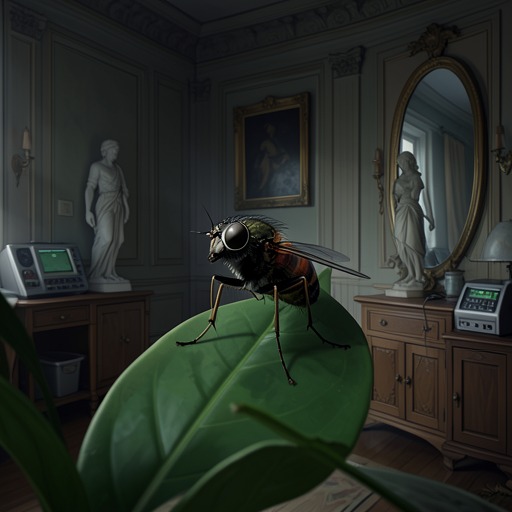
Maya first notices a fly on the broad leaf beside her. It races in jerks along the green veins, darts from one part of the leaf to another, and periodically lifts into the air with a burst of buzzing before settling again. Its sudden changes of direction make it seem at times to hop rather than fly; after these restless movements, it can also sit perfectly still. This contrast between agitation and immobility gives the encounter its comic rhythm before the insect has even introduced itself.
When Maya greets it, the fly identifies himself as Puck and says he is busy, asking whether she intends to drive him away. Maya welcomes his company and asks whether he knows about human beings. Puck reacts as though the answer should be obvious: he claims to know them from sitting on their clothes every day. His assurance immediately establishes a difference between the two insects. Maya approaches people as a subject she longs to understand; Puck presents them as familiar territory, though his knowledge is partial and shaped by his own practical interests.
Puck’s physical behavior adds to his singular presentation. After Maya believes him, he tries to pull off his head, alarming her. He calmly insists that he must do this, then slides his legs over his wings and explains that he is not merely a fly but a housefly who has come out for fresh air. The episode is presented through Maya’s surprise and Puck’s composure: what looks extraordinary to her is, to him, an unremarkable action that she simply does not understand.
A Life Among Humans
Puck says that his knowledge comes from having grown up in a human home. His mother laid the egg from which he emerged in a corner of a room; his first attempts at walking took place on the window shades, and he tested his wings by flying from Schiller to Goethe. These small details make the human dwelling not an abstract setting but the environment in which he acquired his habits. From Puck’s account, rooms, furniture, and the people who occupy them form the everyday world of a housefly.
He presents the flies as bold, claiming that they do not flee unless retreat is useful and that they return afterward. This boast anticipates the domestic story he tells Maya. Rather than describing people from a distance, Puck depicts repeated encounters with one elderly man in the home where he lives. The story makes his asserted familiarity concrete while keeping its comic imbalance: Puck understands the encounter as a contest governed by his own agility, while the man does not know how much of the exchange the fly is observing.
The Game with the Elderly Man
Puck describes a routine involving a man who keeps a sweet-smelling drink in a cupboard. When the man takes a glass, he looks upward as if checking whether Puck is present, then gestures across his face to indicate where the fly may settle later. After the man lies down on a sofa and falls asleep, Puck takes a portion from the glass and moves to his forehead. The fly interprets the forehead’s furrows as tracks associated with thinking, and distinguishes them from the folds that appear when the man is annoyed.
The man tries to catch Puck, but the fly waits until the last moment and darts aside. He portrays the man’s unsuccessful attempts as part of a game that can continue for as long as half an hour. Eventually the man rises and voices his frustration; Puck, already able to escape to the ceiling, treats the complaint as no reason to regret the amusement. The episode depends on a reversal of scale and attention: the human being believes he is reacting to a troublesome insect, while Puck describes himself as calmly directing the timing of the encounter.
Puck’s account does not make him an impartial interpreter of humanity. He recasts the man’s actions as cues for his own amusement, and his explanation of facial features begins from what a fly can observe while standing on them. Yet the story also demonstrates his close attention to human gestures, routines, and changes of expression. His familiarity is practical and intimate, not a complete understanding of human motives.
Narrative Role and Perspective
Puck’s encounter gives Maya a vivid but slanted answer to her questions about people. His confidence makes him entertaining, while the details of his tale expose the limits of his supposed expertise: he knows where the man keeps a glass, recognizes recurring gestures, and can anticipate attempts to catch him, but interprets these observations according to the housefly’s own concerns. The human world is thus rendered from an insect’s low, mobile vantage, where a forehead becomes terrain and a household routine becomes an opportunity for play.
As a representative of the Houseflies in this episode, Puck combines observable insect behavior with a distinctly humanlike capacity for boasting and storytelling. The narrative does not establish that every housefly shares his character or experiences; it gives one named fly a particular history and voice. His tale makes the ordinary human home newly strange without resolving Maya’s broader curiosity. Instead, it shows that seeing people closely is not the same as understanding them: Puck’s intimate access supplies memorable observations, but his comic self-assurance remains inseparable from the narrow perspective through which he explains them.